Doubao Seed2.0: ByteDance's Official Pro, Lite, Mini, and Code Model Guide
Seed2.0 is ByteDance Seed’s February 14, 2026 family release for large-scale production deployment and long-horizon real-world tasks. The cleanest public story comes from four official surfaces used together: the Seed2.0 model page for the family overview and live entry points, the launch blog for the Pro/Lite/Mini plus dedicated Code rollout, the model card for benchmark depth, and Volcengine / Ark for product access. That source chain is materially stronger than copying reseller-style price tables or unrelated market-share claims.
- The official model page exposes Model Card, Tech Blog, Try Now, and API entry points on one page.
- The public family story starts with three general-purpose models: Pro, Lite, and Mini; the launch blog separately calls out a dedicated Code model.
- The public benchmark table on the Seed page already shows strong flagship rows such as BrowseComp 77.3, τ2-Bench Retail 90.4, τ2-Bench Telecom 94.2, and Terminal Bench 2.0 55.8.
- ByteDance frames Seed2.0 around multimodal understanding, long-horizon agent work, and real-world production deployment rather than a single benchmark headline.
What ByteDance officially launched
The official Seed2.0 model page presents three general-purpose agent models of different sizes: Pro, Lite, and Mini. The page’s wording is operational rather than marketing-heavy: Pro is for long-chain reasoning and robustness in complex workflows, Lite balances output quality and response speed, and Mini is optimized for inference throughput and deployment density.
The official launch blog adds the missing fourth route: a dedicated Code model. That blog also states that the Pro and Code models launched on the Doubao App and TRAE, while the full Seed2.0 series API is available on Volcano Engine. That is the cleanest public way to explain the family without inventing unsupported product segmentation.
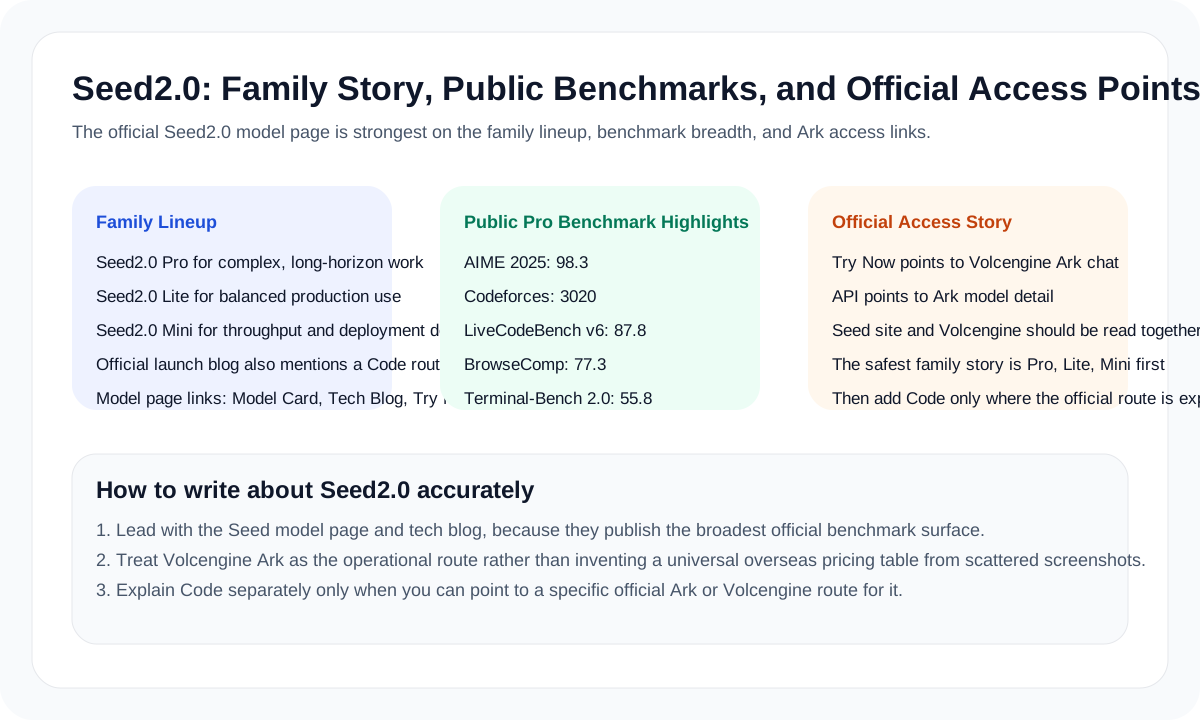

Official screenshot
The official Seed2.0 page is the cleanest public source for the model-family story
ByteDance's Seed site makes the Pro, Lite, and Mini lineup, benchmark breadth, and Ark access links visible in one place. That is stronger than building the article around unofficial pricing screenshots.
- Best official visual for the Seed2.0 family overview.
- Useful for replacing reseller-style descriptions with Seed's own model framing.
Source: Official Seed2.0 model page.

Official image
Seed2.0 Pro is the flagship long-chain reasoning lane on the official model page
This image is served directly from the official Seed2.0 page. It represents the flagship Pro lane in the public family overview, while the same page separately presents Lite and Mini.
- Useful when the article needs a direct official asset from the live Seed page instead of only a local screenshot.
- Helps keep the Pro versus Lite versus Mini story tied to Seed’s own product framing.
Source: Official Seed2.0 model page.
| Model or route | Official positioning | Best fit | Source note |
|---|---|---|---|
| Seed2.0 Pro | Focuses on long-chain reasoning and robustness in complex workflows | Complex real-world tasks and high-stakes agent runs | Official Seed2.0 model page |
| Seed2.0 Lite | Balances output quality and response speed | General-purpose production deployment | Official Seed2.0 model page |
| Seed2.0 Mini | Optimized for inference throughput and deployment density | High-concurrency and batch-generation scenarios | Official Seed2.0 model page |
| Seed2.0 Code | Dedicated code route highlighted in the launch blog | Coding-first workflows on Doubao App, TRAE, and Ark | Official launch blog |
What the official benchmark pages actually prove
The public Seed2.0 model page and the linked Model Card publish a broad benchmark surface, but the safest rows to reuse in an English buyer guide are the ones clearly visible on the official model page. Those rows already show why ByteDance frames Seed2.0 around long-horizon agent work, search-heavy tasks, and tool use rather than only around one coding number.
For practical writing, it is better to quote a small set of official rows cleanly than to overcompress the entire model card into one exaggerated claim. The strongest public rows on the model page include BrowseComp 77.3, BrowseComp-zh 82.4, τ2-Bench Retail 90.4, τ2-Bench Telecom 94.2, Terminal Bench 2.0 55.8, and XPert Bench 64.5 for the flagship row.
| Benchmark | Official score | Why this row matters |
|---|---|---|
| BrowseComp | 77.3 | Shows strong search-agent performance on the public Seed page. |
| BrowseComp-zh | 82.4 | Useful for Chinese-language browsing and retrieval tasks. |
| HLE-Verified | 73.6 | Signals broad high-difficulty knowledge capability. |
| DeepSearchQA | 77.4 | Useful for research and verification-style workflows. |
| τ2-Bench (retail) | 90.4 | Strong tool-use score in an applied domain. |
| τ2-Bench (telecom) | 94.2 | Another strong applied tool-use row. |
| Terminal Bench 2.0 | 55.8 | Shows multi-step agent execution on a public coding benchmark. |
| XPert Bench | 64.5 | Helpful as a professional-task benchmark row. |
These are the easiest source-backed benchmark rows to reuse directly from the official Seed2.0 model page.
Official Seed2.0 model page.
Official Seed2.0 model page.
Official Seed2.0 model page.
Official Seed2.0 model page.
Official Seed2.0 model page.
Official Seed2.0 model page.
Source: Official Seed2.0 model page.
Real-world product signals: multimodal apps and long-horizon tasks
The official model page is unusually useful because it does not stop at benchmark tables. It shows concrete product-style examples: turning a single image into a web page with layout and animation restoration, complex chart understanding and reconstruction, CAD design and operation in FreeCAD, biotechnology research support, and Solovay-Kitaev algorithm repair.
This matters because it gives a better public picture of Seed2.0 than a one-line “frontier model” label. ByteDance is showing a model family intended for visual understanding, tool use, long-horizon execution, and professional workflows that mix reasoning with structured real-world actions.
Official image
The FreeCAD workflow example grounds Seed2.0 in real multi-step tool execution
ByteDance uses this workflow image on the public Seed2.0 page to show a concrete professional task, which is stronger than a generic claim that the model is good at “agent work.”
- Useful for the section about long-horizon professional workflows and tool use.
- A better official visual for applied execution than a copied benchmark slide.
Source: Official Seed2.0 model page.
| Scenario | What the official page shows | Why it matters |
|---|---|---|
| Single image to web page | Generates functional front-end code with restored layout, visual detail, and interactive extensions | Strong public signal for visual-to-code and UI generation. |
| Complex chart understanding | Processes structured information from chart-heavy inputs | Useful for document and analytics workflows. |
| CAD Design and Operation | Handles end-to-end modeling and geometric-parameter extraction in FreeCAD | Good example of long-horizon tool execution. |
| Biotechnology Research Support | Positions Seed2.0 for research and scientific workflows | Supports the “research-grade tasks” framing in the launch blog. |
| Solovay-Kitaev Algorithm Repair | Shows math-and-code reasoning in a specialized domain | Good evidence that the model is not only tuned for generic chat. |
Access routes: Seed site first, Ark pricing second
The official Seed2.0 model page already gives readers a useful route map: Model Card for deeper technical detail, Tech Blog for the launch narrative, Try Now for a hosted entry point, and API for the Ark console route. The launch blog then confirms that the full Seed2.0 series API is available on Volcano Engine.
What the official public pages do not currently give, at least not in one clean buyer-facing place, is a single universal public Seed2.0 token-pricing table that should be copied blindly into comparison content. The right way to write this guide is to point readers to Ark / Volcengine for the exact model ID, route, and region they intend to buy, then verify the live console row before quoting prices.
- The official model page links directly to both Try Now and API, which is rare and useful for readers.
- The launch blog says the Pro and Code models launched on Doubao App and TRAE, while the full-series API is on Volcano Engine.
- If you need buyer-facing pricing content, verify the exact Ark route and token row live before you publish. Do not flatten Seed2.0 into one copied “global price.”
| Route | What is public | Best fit | Pricing guidance |
|---|---|---|---|
| Seed2.0 model page | Overview, benchmark table, Model Card, Try Now, and API links | First-stop research and route discovery | No single public “copy this price table” row is presented here. |
| Try Now | Hosted evaluation entry linked from the model page | Fastest path to product testing | Treat this as an evaluation surface, not as a pricing document. |
| Ark console API | Official API detail entry linked from the model page | Developers integrating through Volcano Engine | Verify the exact live token row in the target region before publishing numbers. |
| Volcengine Doubao product page | Product route for the wider Doubao / Ark surface | Buyer-facing product confirmation | Use it for route validation, not as a substitute for live console pricing. |
Start from the official Seed2.0 page, then verify the exact Ark route you need
The model page is the best public source for the family overview and benchmark surface. Ark is the place to confirm the live model ID, region scope, and pricing row that applies to your actual integration route.
Sources and official links
Frequently asked questions
What is the difference between Seed2.0 Pro, Lite, Mini, and Code?
The official model page defines Pro, Lite, and Mini as the three general-purpose Seed2.0 models: Pro for long-chain reasoning and complex workflows, Lite for balanced production use, and Mini for throughput and deployment density. The launch blog separately introduces a dedicated Code route for coding-first workflows and says the Pro and Code models launched on the Doubao App and TRAE.
How do I access Seed 2.0 models via API?
Use the official API entry linked from the Seed2.0 model page, which opens the Ark console route on Volcano Engine. The launch blog also explicitly says the full Seed2.0 series API is available on Volcano Engine. Start from the Seed page if you want the clearest public route map.
Does ByteDance publish one universal public Seed2.0 price table?
Not in one clean, buyer-facing public page that this guide should flatten into a single global price. The official Seed page is strongest for family overview and route entry points; the live Ark console is the right place to verify the exact model ID, region, and current token-pricing row before you quote numbers.