Which AI Coding Plans Work with OpenClaw in 2026? GLM vs MiniMax vs Kimi vs MiMo
If you searched for OpenClaw provider support, the short answer is yes: GLM, MiniMax, Kimi, and MiMo all have public OpenClaw routes. The useful answer is which route you need, whether the flow is plan-based or API-based, and how much manual configuration is involved.
- All four providers have public OpenClaw routes worth covering.
- The most important OpenClaw keyword is not “support.” It is “which auth route does this use?”
- MiMo is the clearest example of why OpenClaw support and one-click setup are not the same claim.
Short answer: all four work with OpenClaw, but not in the same way
GLM, MiniMax, Kimi, and MiMo all have public OpenClaw guidance strong enough to support an external article. That part is easy.
What readers actually care about is what sits behind the support claim: which provider route they have to choose, whether the flow is plan-based or API-based, and whether the provider is preset or manual. That is the part this guide keeps front and center.

Official screenshot
OpenClaw has a strong public docs hub worth linking directly
The main OpenClaw docs page gives readers a quick sense of what OpenClaw is, how the project is organized, and where onboarding starts.
- Useful for readers who discovered OpenClaw from social posts and still need the official entry point.
- Works well as the first image in provider-comparison articles.
Source: Official OpenClaw docs.

Official screenshot
MiniMax documents OpenClaw as a Token Plan workflow, not just a generic compatibility claim
The provider page helps readers see that “supports OpenClaw” still means a specific plan, setup path, and model route.
- Useful for articles comparing OpenClaw support depth, not just support existence.
- Shows that MiniMax pairs provider support with a dedicated integration page.
Source: MiniMax OpenClaw page.

Official screenshot
MiMo’s OpenClaw page makes the route split more explicit than most providers
The official MiMo integration page is in Chinese, but it is still useful because it clearly signals that both PAYG and Token Plan routes exist and should not be treated as one setup.
- Helpful when explaining why MiMo is not a simple one-click equivalent to every other provider.
- Adds source-backed context to the PAYG vs plan-based OpenClaw discussion.
Source: Official MiMo OpenClaw page.
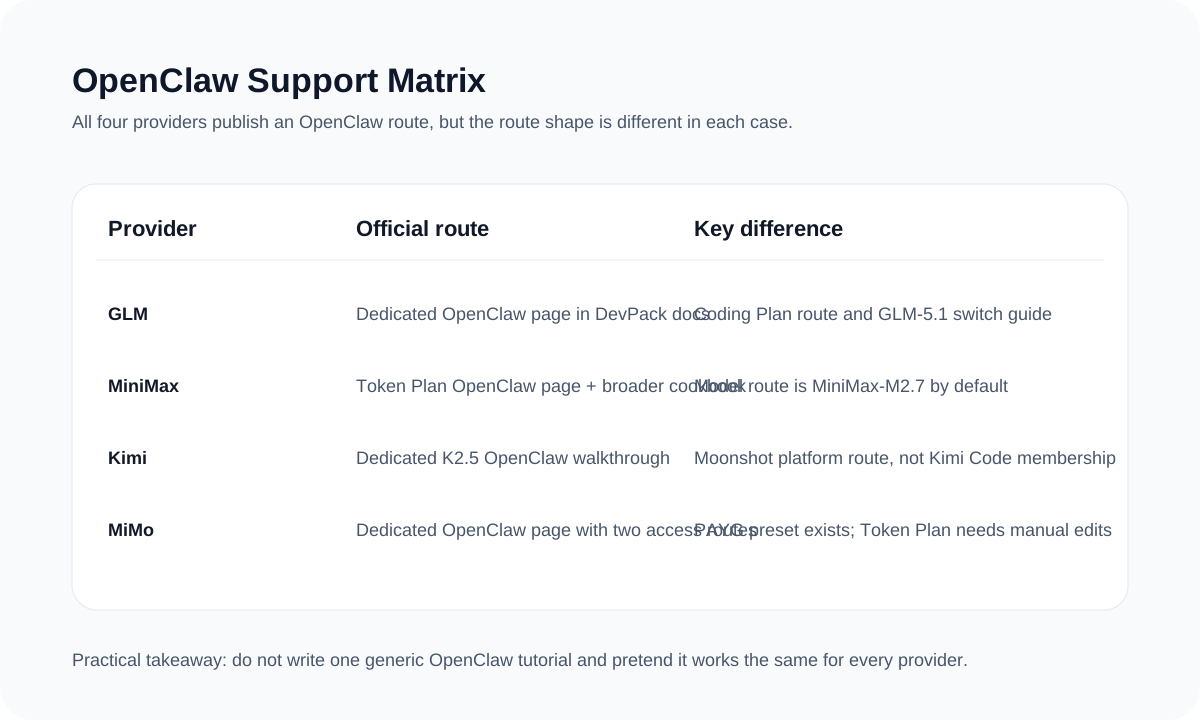
OpenClaw support comparison
| Provider | Official OpenClaw page | Main route | What to tell readers first |
|---|---|---|---|
| GLM | Yes | DevPack / Coding Plan route | Keep Coding Plan and general API billing separate |
| MiniMax | Yes | Token Plan route with model defaults around MiniMax-M2.7 | Explain region endpoints and route choice clearly |
| Kimi | Yes | Moonshot Open Platform K2.5 route | Do not describe it as a Kimi Code membership flow |
| MiMo | Yes | PAYG and Token Plan both exist, but they are not equally automatic | Explain preset-provider vs manual-provider differences explicitly |
Which provider is easiest to start with in OpenClaw?
- Start with GLM if you want the clearest subscription-style OpenClaw story.
- Start with MiniMax if you also want to compare OpenClaw with strong Claude Code and Cursor docs.
- Start with Kimi if your main goal is a direct K2.5 platform setup flow.
- Start with MiMo if your article needs to teach the difference between PAYG and plan-based OpenClaw access.
The most common OpenClaw writing mistakes
- Saying a provider “supports OpenClaw” without naming the route.
- Treating subscription access and direct API access as the same setup path.
- Calling every route “one-click” when some still require manual provider blocks.
- Explaining the default model but not the auth method behind it.
Put the provider route at the top of the OpenClaw article
That one choice usually makes the guide much more useful to actual readers.
Sources and official links
Frequently asked questions
Which provider is easiest to explain in an OpenClaw article?
GLM is the easiest plan-first story. MiniMax is the easiest docs-first story. Kimi is the easiest K2.5 platform story. MiMo is the best example of why route details matter.
Can MiMo Token Plan use the same OpenClaw onboarding flow as MiMo PAYG?
No. The official docs distinguish them clearly. PAYG has a preset Xiaomi provider, while Token Plan still requires manual provider configuration.
Why should Kimi OpenClaw coverage stay separate from Kimi Code coverage?
Because the official OpenClaw route is documented on the Moonshot Open Platform side, not as a Kimi Code membership flow.