Kimi K2.5 Pricing in 2026: Kimi Code vs Moonshot API
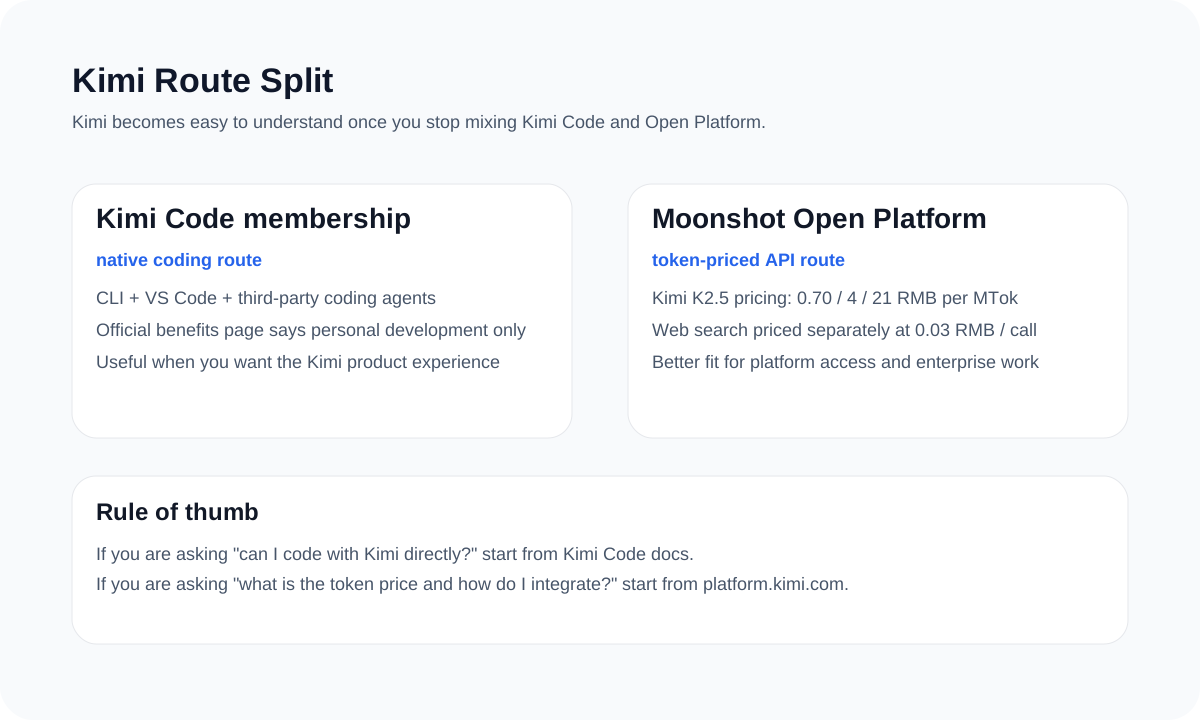
If you searched for Kimi price, Kimi K2.5 cost, or Kimi Code vs Moonshot API, split the question in two before you do anything else. Kimi Code is a coding membership product. Moonshot Open Platform is a token-priced API platform. Mixing them is why most Kimi pricing posts confuse readers.
- Kimi Code is a coding product with Kimi CLI, VS Code, and compatibility routes for third-party agents.
- Moonshot Open Platform is the API side, where `kimi-k2.5` token pricing and tool fees are published.
- As of April 20, 2026, BuyGLM displays the public K2.5 API pricing as $0.0875 cached input, $0.50 input, and $2.63 output per MTok from the official mainland pricing table.
- Kimi Code keys, China Open Platform keys, and global Open Platform keys are not interchangeable.
Before you compare Kimi prices, split the product into two
Kimi is not one product with one pricing page. Kimi Code is the route for Kimi CLI, VS Code, and Kimi Code keys. Moonshot Open Platform is the route for token pricing, tool fees, and product-side API integrations.
That is why search queries like “Kimi Code price” and “Kimi K2.5 pricing” need different answers. They are not two labels for the same bill, and any article that treats them like one route usually becomes confusing by paragraph two.

Official screenshot
Kimi Code is presented as a membership-style coding product
The official Kimi Code page frames the route around coding workflows, official clients, and membership access rather than raw token billing.
- Useful for readers searching for Kimi Code plans, Kimi CLI, or Kimi Code membership.
- A strong visual reminder that Kimi Code and Moonshot Open Platform are different routes.
Source: Kimi Code page.

Official screenshot
The K2.5 API price table lives on the Moonshot Open Platform side
This official pricing page is the cleanest source for cached input, input, and output pricing. The docs UI may default to Chinese depending on region, but the table is still the source-backed pricing reference.
- Best visual proof for readers asking about `kimi-k2.5` token cost.
- Pairs well with the Kimi Code page to show why membership pricing and API pricing should not be mixed.
Source: Official Kimi K2.5 pricing.
What Kimi Code membership actually gives you
Kimi Code is best described as a coding membership product, not as a generic enterprise API package. The public benefits page explicitly frames it around personal development use, official clients, and compatibility with third-party coding agents.
The public docs also clarify that usage rolls on a 7-day cycle from the subscription start date and does not carry over. That matters more to most readers than a vague “pro” or “premium” label.
| Topic | Public answer | Why it matters to readers |
|---|---|---|
| Usage boundary | Primarily positioned for personal development | Prevents readers from treating it like a broad enterprise API plan |
| Official clients | Kimi CLI and VS Code are part of the route | Explains why Kimi Code is not just a pricing wrapper |
| Third-party agent use | Officially documented | Useful for Claude Code and Roo Code search intent |
| Quota reset | 7-day rolling from the subscription effective date | Helps readers estimate usage correctly |
| Published price table | Verify on the current plan page | Avoids copying stale screenshots into a public article |
Moonshot Open Platform K2.5 pricing and tool costs
If the reader is actually asking about API cost, the public K2.5 pricing page is the correct source. This is where token pricing and tool pricing belong.
| Cost bucket | Official page | When it applies |
|---|---|---|
| Kimi Code membership | Kimi Code docs and plan page | When the user wants the coding-product route |
| K2.5 token pricing | Moonshot Open Platform pricing | When the user is calling the platform API directly |
| Tool costs | Moonshot tools pricing | When the workflow uses Web Search or other priced tools |
This is the Moonshot Open Platform API route, not Kimi Code membership pricing. BuyGLM shows the USD-normalized view of the official mainland pricing table.
USD-normalized from the cached-input line on the official mainland table.
USD-normalized from the input line on the official mainland table.
USD-normalized from the output line on the official mainland table.
BuyGLM also displays Web Search at about $0.0038 per call from the public tools pricing page. Source: Official Kimi K2.5 pricing.
Keys, endpoints, and the most common Kimi billing mistake
A Kimi buying guide is incomplete if it does not cover the route-specific endpoints. Kimi Code uses the coding endpoints such as `https://api.kimi.com/coding/` or `https://api.kimi.com/coding/v1`, while Moonshot Open Platform uses `https://api.moonshot.cn/v1` for China and `https://api.moonshot.ai/v1` for the global platform.
That is also why readers end up with 401 errors even after paying. They are often using a valid key on the wrong route.
Decide whether the reader wants Kimi Code or K2.5 API before you write the price section
That one split does more for clarity than any amount of pricing detail added later.
Sources and official links
Frequently asked questions
Is Kimi Code the same product as Moonshot Open Platform K2.5?
No. Kimi Code is the coding-product route. Moonshot Open Platform is the API route.
Why is my K2.5 bill higher than the token price I calculated?
Because tool costs can be separate. The public docs still list Web Search as an additional priced tool call.
Can I use Kimi Code in Claude Code or Roo Code?
Yes. The official Kimi Code third-party agent docs cover those compatibility routes.
Where should I check the final Kimi Code price before publishing or buying?
On the current Kimi Code plans page or membership display page, because that is the part most likely to move over time.