MiniMax Token Plan Pricing in 2026: Starter, Plus, Max, Highspeed, and PAYG
If you searched for MiniMax Token Plan pricing, MiniMax Highspeed, or MiniMax PAYG vs Token Plan, start here: Token Plan is now the main public subscription route, old Coding Plan pages still clutter search results, and the biggest source of confusion is mixing standard monthly tiers, annual pricing, and separate PAYG rates.
- MiniMax publicly frames Token Plan as the current route built on top of the former Coding Plan path.
- Starter, Plus, and Max publish both monthly and annual prices, while the Highspeed tiers are currently annual in the public table.
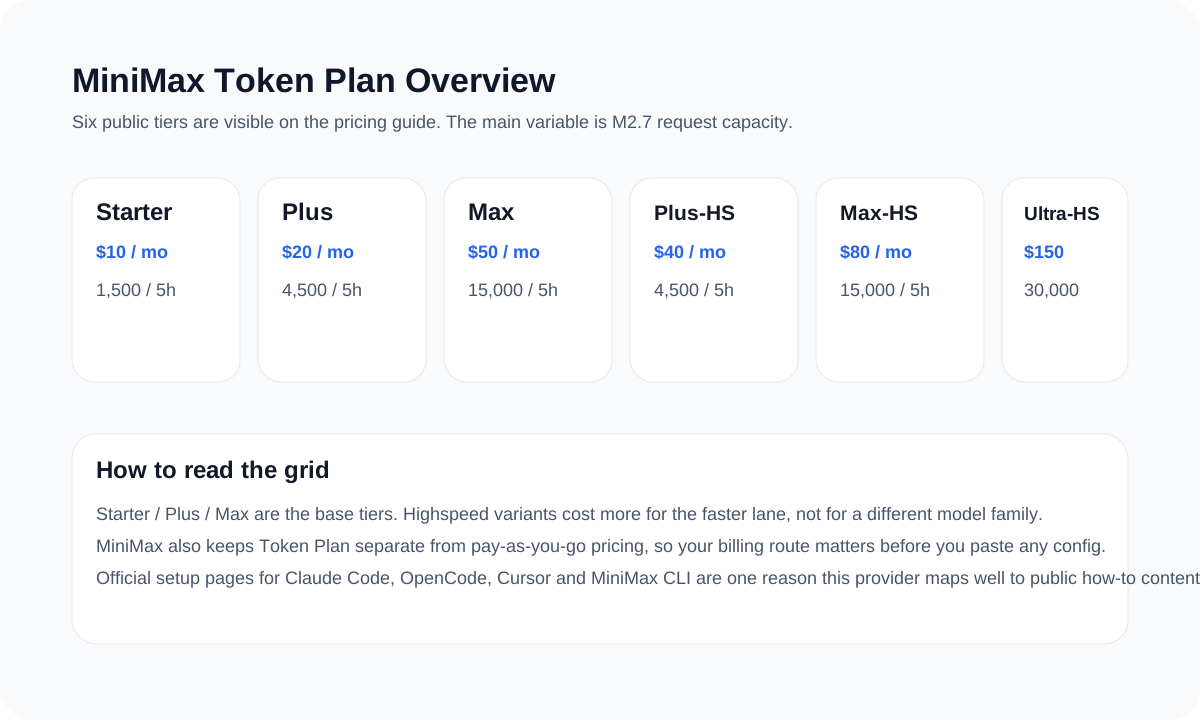
- The published M2.7 5-hour request limits range from 1,500 to 30,000 across the six tiers.
- PAYG is still the cleaner route for fluctuating API-heavy usage.
Why MiniMax pricing still confuses people in search
MiniMax has already moved the main public story to Token Plan, and the current overview explicitly describes it as extending the former Coding Plan. Readers still get confused because old Coding Plan pages continue to show up in search results.
That is why a good MiniMax pricing article needs to say which page is current instead of simply copying whichever pricing table ranked first. If the page does not make that clear, readers end up comparing old and new routes without realizing it.

Official screenshot
MiniMax clearly positions Token Plan as the current subscription route
The official Token Plan overview is the best first stop for public-facing articles because it explains the route before readers ever hit a pricing table.
- Useful for queries around MiniMax Token Plan, MiniMax Coding Plan, and MiniMax subscription.
- Helps clarify that Token Plan is the current public route readers should treat as primary.
Source: MiniMax Token Plan overview.

Official screenshot
MiniMax publishes a strong public pricing table for monthly and Highspeed tiers
This pricing-table view is one of the best official screenshots in the category because readers can verify standard and Highspeed tiers directly from the source page.
- Shows the monthly standard tiers and the Highspeed plan table in one view.
- A good visual checkpoint before repeating plan prices or 5-hour request limits in an article.
Source: MiniMax Token Plan pricing.
The Token Plan pricing table that matters
| Tier | Billing | M2.7 5-hour limit | Best fit |
|---|---|---|---|
| Starter | $10/month or $100/year | 1,500 | Low-cost testing and light use |
| Plus | $20/month or $200/year | 4,500 | A strong middle tier for many individual users |
| Max | $50/month or $500/year | 15,000 | Heavy daily coding and larger workflows |
| Plus-Highspeed | $400/year | 4,500 | Users who care more about access quality than raw limit growth |
| Max-Highspeed | $800/year | 15,000 | Heavier use with the premium route |
| Ultra-Highspeed | $1,500/year | 30,000 | Team or high-intensity workloads |
This is the fastest way to judge whether you need a standard tier or a Highspeed tier.
$10/month or $100/year.
$20/month or $200/year.
$50/month or $500/year.
$400/year.
$800/year.
$1,500/year.
The public table still shows standard tiers with monthly and annual pricing, while Highspeed remains annual. Source: Official MiniMax Token Plan pricing.
Token Plan vs PAYG: what the reader is really choosing
Token Plan is a budget-locking subscription route. PAYG is the better fit when usage fluctuates, when you are building product workflows, or when you need to track direct token cost instead of buying a bundled plan.
As of April 20, 2026, the public PAYG page still lists M2.7 at $0.3 per MTok input and $1.2 per MTok output, with M2.7-Highspeed at $0.6 and $2.4. That makes PAYG especially easy to justify for variable or infrastructure-heavy usage.
| Route | Best for | Less ideal for |
|---|---|---|
| Token Plan | Predictable monthly or annual usage with a need to cap budget | Highly variable or infrequent API-heavy usage |
| PAYG | Product integration, fluctuating demand, detailed usage accounting | Users who want one fixed subscription answer |
The two pricing mistakes that show up most often
- Treating the Highspeed tiers as monthly when the public table currently shows them as annual.
- Comparing Token Plan request limits directly to PAYG token pricing as if they were the same cost unit.
Separate current Token Plan pricing from old Coding Plan pages before you publish
That one check eliminates most MiniMax pricing confusion in public-facing articles.
Sources and official links
Frequently asked questions
Is MiniMax Highspeed monthly or annual?
As of April 20, 2026, the public table shows the Highspeed tiers as annual pricing, not monthly.
Is Token Plan the same thing as PAYG?
No. Token Plan is the bundled subscription route. PAYG is direct usage pricing.
Why do I still see Coding Plan pages in search?
Because Token Plan publicly extends the former Coding Plan route, and older pages still surface in search results.
Is MiniMax only a coding plan?
No. Token Plan is better described as a multimodal plan with strong coding relevance, not as a code-only subscription.